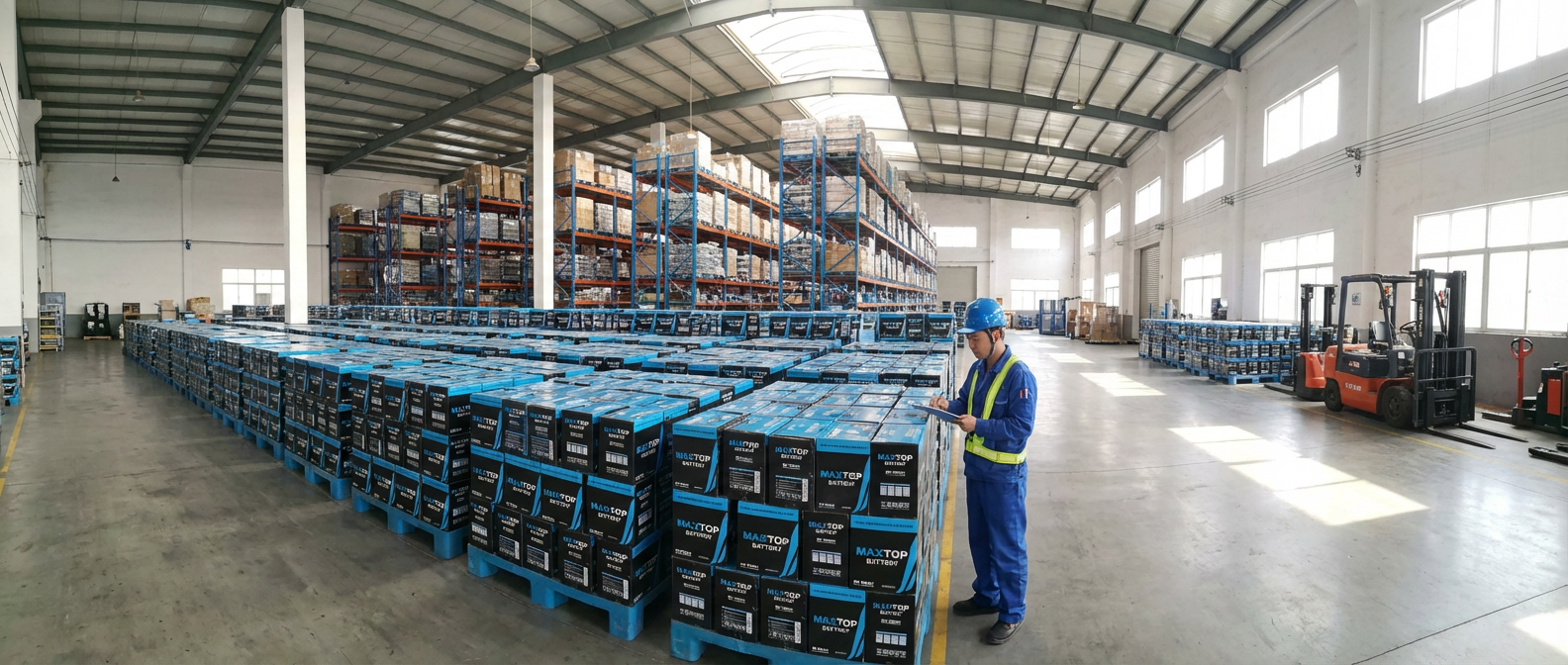
Today, a customer friend from Peru sent us a quotation inquiry for a 20-foot container of batteries — 15 models in total, neatly listed from 36Ah small-car batteries to 220Ah heavy-duty batteries, and they even double-checked the real CCA figures, number of plates for each battery size. To be honest, we really appreciate that kind of professionalism: knowing the product, knowing the specs, and knowing their own market.
With this inquiry in mind, we’d like to talk about Peru’s roads and car models, and what kind of battery each vehicle actually needs — and, by the way, why more and more customers are ultimately placing their orders with MAXTOP.
Peru — a market dominated by “Japanese specs”
Let’s start with a few figures. In 2025, the Peruvian light-vehicle market hit a record high, with annual sales of about 187,000 units, up 23.8% year-on-year. In this market, Toyota has held the No. 1 sales position for 34 consecutive years, with a market share of about 20.5%; the brands behind it — Hyundai, Kia, Suzuki, Nissan — are almost all Japanese and Korean. (Market data sources are listed in Appendix A at the end.)
What does this mean? It means the Peruvian market has a huge demand for batteries in JIS (Japanese Industrial Standard) specifications. From 55B24L and 56219 to 80D26, 95D31, N100/N120, these models are real “hard currency” in Peru — which also explains why our customer’s inquiry was almost entirely in Japanese specs.
On top of that, Peru is a mountainous, highland country where pickups and SUVs are the most popular choices for both family and commercial use. Vehicles carry heavy loads and start and stop frequently, which places especially high demands on cold-cranking performance (CCA) and durability. In short: Peruvians buy Toyota for their cars, Japanese specs for their batteries, and reliability when choosing a supplier.
Peru’s mainstream car models × corresponding battery specs
The table below is a selection reference compiled from Peru’s best-selling models and common battery specifications. Please note: this is a common market-matching reference; for a specific vehicle, please refer to the original manufacturer’s manual, the label on the battery tray, or actual measurement.
Table 1. Peru mainstream car models and common automotive battery specifications (reference)
Vehicle type | Representative models in Peru | Common battery models |
Small / city commuter | Suzuki Swift, Hyundai Grand i10, Kia Rio, Chevrolet Sail | 53646 / 55B24L |
Compact sedan | Toyota Yaris, Nissan Versa, Kia Soluto | 55B24L / 56219 |
Mid-size sedan | Toyota Corolla, Nissan Sentra | 56219 / 57540 |
Compact SUV | Hyundai Tucson, Kia Sportage, Ford Territory | 57540 / 80D26L |
Mid-size SUV / crossover | Toyota Corolla Cross, RAV4, Nissan Kicks | 80D26L / 80D26R |
Pickup | Toyota Hilux, Nissan NP300, Mitsubishi L200 | 95D31L / 95D31R |
Large SUV / light commercial | Toyota Rush, Land Cruiser, commercial vehicles | 100R / N100 |
Commercial / light truck | Logistics, freight, construction | N120 / N150B |
Heavy truck / bus | Long-haul transport, public transit | 67029 / 73011 |
Take the best-selling Toyota Hilux, for example. It has long been Peru’s “best-selling vehicle in the country” and is almost a standard choice in mining, agriculture, and logistics. Its most common matching battery is the 95D31L/R — a high-current, high-CCA specification. When stocking for customers, the pickup tier is usually the main volume.
Why more and more customers choose MAXTOP
Once the model is right, the next step is choosing the supplier. Let’s be straightforward about why customers keep coming back to us:
- Real CCA — no empty promises. Many competitors quote “ideal” CCA figures, while we always state real, measurable CCA and are happy to compare each value against customer requirements, so every battery’s data stands up to scrutiny.
- Solid materials, proper workmanship. We use high-performance grids and optimized plate technology, with strict control from material to assembly. The service life and consistency of a lead-acid battery lie in exactly these invisible details.
- A warranty we stand behind. We confidently back every MAXTOP battery with a 36-month warranty — not just a slogan, but confidence in our own product.
- We understand foreign trade — and private labeling. We support OEM/own-brand cooperation, with one-stop support from model customization and packaging design to shipping documentation. You sell your own brand; we are your reliable partner behind it.
- Transparent pricing, stable delivery. Exchange rates and lead prices fluctuate, and we always clearly state the validity period of our current prices — we never change them at the last minute.
Conclusion
The Peruvian market is large, but there are not many suppliers who “know the vehicles, know the specs, and are truly reliable.” If you are also looking for a battery you can trust for mainstream models like the Hilux, Corolla, or Tucson, MAXTOP is happy to be your long-term, stable partner.
We welcome your inquiries to our email sales@maxtopbatteries,com or 7*24h Whatsapp 0086-183 6429 4132 — we take every specification sheet seriously.