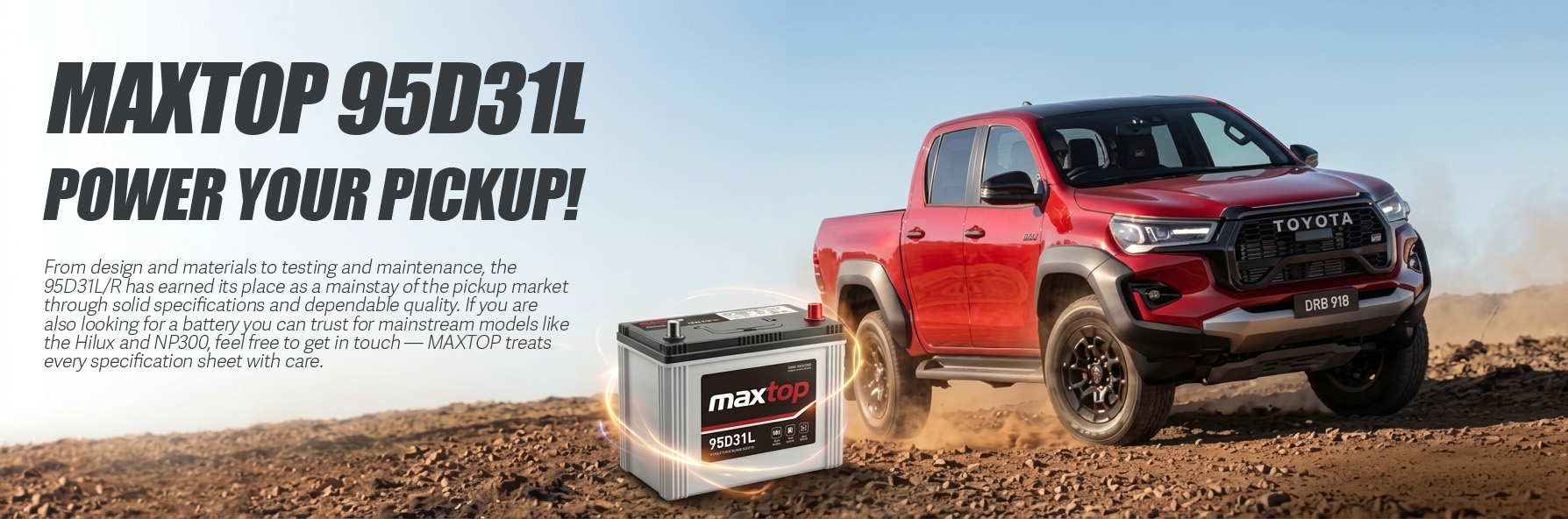
In Peru and across Latin America, the Toyota Hilux has topped the best-seller charts for years on end — you see it everywhere, in mining sites, farmland, and logistics routes. And the battery it runs on, nine times out of ten, is the 95D31L/R. Why does this battery matter so much? What lets it shoulder the starting duty of a pickup? Let’s break it down.
Product Design: A Spec Built for the Heavyweights
The 95D31L/R is one of the mainstream specifications in the JIS (Japanese Industrial Standard) system, measuring approximately 300×172×224 mm and belonging to the D31 series. The “L/R” here refers to the polarity orientation of the terminals — viewed from the front of the battery, positive on the left is L and positive on the right is R. When selecting a battery, make sure it matches the terminal orientation of the original unit.
Its design purpose is clear: large capacity (about 90Ah) combined with high cold-cranking current (real CCA around 730), built specifically for pickups and SUVs — large-displacement, high-load vehicles with frequent start-stop duty. Structurally, it uses a maintenance-free valve-regulated design, fully sealed and requiring no water topping. Inside, its six cells work with high-performance grids and optimized plates to deliver both burst power in cold starts and long-term endurance.
Raw Material Selection: Quality Starts at the Source
Whether a battery is good or not comes down largely to its materials. The 95D31L/R is particularly careful in this respect: its grids use high-purity lead and lead-calcium alloy, which resist corrosion and keep self-discharge low for a more stable service life; the positive and negative active materials are strictly formulated to ensure charge and discharge efficiency; separators use high-spec AGM/PE material, resisting vibration and preventing short circuits — a real advantage for pickups on rough roads; and the case is impact-resistant PP with leak-proof terminals to secure proper sealing.
For us, grid and plate technology is the core. MAXTOP insists on high-performance grids and optimized plate technology, with control throughout the process from incoming material to assembly — the service life and consistency of a lead-acid battery lie precisely in these invisible details.
Compatible Vehicles: Who “Owns” the 95D31L/R
The 95D31L/R is a common original-equipment choice for pickups and large SUVs. In the Peruvian market, mainstream pickups such as the Toyota Hilux, Nissan NP300, Mitsubishi L200 and Ford Ranger are often matched with this specification in many configurations; some large SUVs, off-road vehicles, and commercial or light-commercial vans also use it. This is why, when stocking for customers, the 95D31L/R is almost always one of the fastest-moving items.
One thing to keep in mind: the same vehicle model may have a different OEM battery specification depending on the year and configuration. When selecting, always refer to the label on the battery tray, the vehicle manual, or the actual original battery, so that both terminal orientation (L/R) and specification match — avoiding a battery that won’t fit or a reversed connection.
Warranty & Testing: Making “Reliable” Measurable
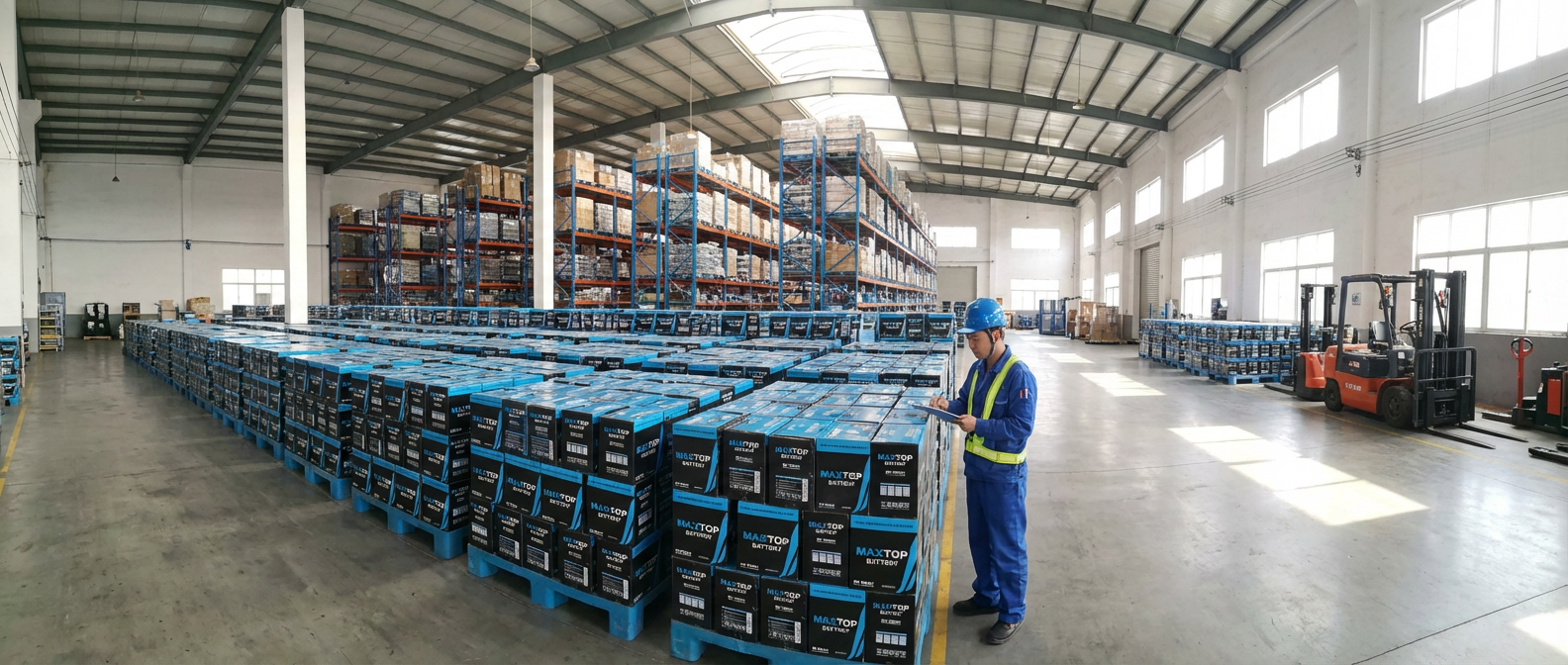
Whether a battery is worth trusting ultimately comes down to testing and warranty. Every MAXTOP 95D31L/R goes through a full inspection before leaving the factory: capacity testing, real cold-cranking (CCA) testing, vibration testing, cycle-life testing, plus seal and pressure checks. We insist on stating real, measurable CCA figures and never inflate them, so the data on every battery stands up to comparison.
It is precisely this confidence that lets us back every MAXTOP battery with a 36-month warranty. A warranty is not a slogan — it is a commitment built on materials, workmanship, and full inspection. That is how we take responsibility for our customers, and for our brand.
Daily Maintenance: Right Care, Longer Life
The 95D31L/R is a maintenance-free design that requires no water topping in normal use, but a few points still deserve attention. First, periodically check the terminals for oxidation or looseness; clean off white corrosion and tighten them promptly — this significantly reduces starting problems. Second, keep the battery well charged: for vehicles parked long-term, use a trickle charger to top it up and avoid over-discharge, which damages the plates. Third, in high-altitude or cold regions, pay attention to cold-cranking performance and charge status. Fourth, watch for the warning signs — weak cranking, dimming lights, a bulging case — and replace the battery in time.
A little care in daily use, and this “powerhouse” will stay with you that much longer.
Conclusion
From design and materials to testing and maintenance, the 95D31L/R has earned its place as a mainstay of the pickup market through solid specifications and dependable quality. If you are also looking for a battery you can trust for mainstream models like the Hilux and NP300, feel free to get in touch — MAXTOP treats every specification sheet with care.