Lead-Acid Battery Raw Material Analysis: How High-Quality Materials Shape the Superior Performance of MAXTOP Batteries
From Grid Alloys to Active Materials: Unveiling the Science Behind Core Battery Components
In the automotive and industrial power sectors, lead-acid batteries maintain a significant position due to their stability, reliability, and cost-effectiveness. Whether for everyday car batteries or the higher demands of SUV batteries and truck batteries, their core performance stems from a frequently overlooked key factor – raw material quality. As a professional battery manufacturer, MAXTOP delves into the science behind lead-acid battery raw materials, revealing how superior materials directly impact battery performance and lifespan.
Basic Structure and Core Materials of Lead-Acid Batteries
The main structure of a lead-acid battery includes components such as the positive plate, negative plate, separator, electrolyte, and battery case/cover. The material choice for each component is crucial:
· Grid Alloy: This is the battery’s skeleton, accounting for about 20%-30% of its total weight. It not only supports the active material but is also responsible for the efficient transmission of current.
· Active Material: This includes lead dioxide in the positive plate and spongy lead in the negative plate. They directly participate in the electrochemical reaction, determining the battery’s capacity and efficiency.
· Electrolyte: This is a sulfuric acid solution. Its concentration and purity directly affect ionic conductivity and reaction stability.
· Separator: This material isolates the positive and negative plates to prevent short circuits while also storing electrolyte. Its quality is related to the battery’s safety and lifespan.
· Battery Case: Acting as the container, it needs characteristics like corrosion resistance, high strength, and impact resistance.
Grid Alloy: The Skeleton and Lifeblood of the Battery
The grid alloy is a key factor affecting battery performance, and its composition directly determines the battery’s service life and maintenance characteristics.
· High-Quality Grid Materials:
MAXTOP batteries utilize optimized low-antimony lead alloys and lead-calcium-tin-aluminum alloys, perfectly balancing strength and corrosion resistance. Low-antimony alloys (antimony content 1.6% ~ 2.4%) can significantly increase grid strength and the battery’s deep cycle capability, while avoiding the maintenance disadvantages of high-antimony alloys. Lead-calcium-tin-aluminum alloys provide excellent corrosion resistance and low self-discharge rates, making them particularly suitable for maintenance-free battery designs.
· Risks of Inferior Grids:
Using recycled lead or non-compliant alloy ratios leads to accelerated grid corrosion, premature capacity loss, and significantly shortened lifespan. Grids with excessive impurity content can form local corrosion cells, accelerating grid fracture and active material shedding.
Active Material: The Core of Energy Storage
High-Quality Active Material:
MAXTOP uses lead dioxide and spongy lead prepared from high-purity lead, ensuring high reaction efficiency and a stable discharge voltage plateau. We also add special carbon materials to the negative active material. Research indicates this can improve charge acceptance by an average of 9% and significantly enhance the battery’s stability during deep discharge.
· Hazards of Inferior Active Materials:
Materials containing impurities or made from recycled materials lead to accelerated sulfation, rapid capacity decay, and premature performance degradation. Unreasonable particle structures reduce the utilization rate of the active material, affecting the battery’s high-rate discharge performance.
Separator and Electrolyte: The Unseen Key Players
High-Quality Separator:
MAXTOP selects Absorbent Glass Mat (AGM) separators and Polyethylene (PE) separators, which feature uniform thickness, good tensile strength, and strong electrolyte retention capability. These characteristics ensure efficient ion conduction and effective isolation of the positive and negative plates.
· High-Quality Electrolyte:
We use high-purity sulfuric acid and deionized water to prepare the electrolyte, strictly controlling impurity content to avoid unnecessary side reactions and accelerated self-discharge.
Impact of Raw Material Quality on Different Application Scenarios
Car Batteries
Automotive starting batteries need to provide high cranking current, placing extremely high demands on grid conductivity and active material reaction rates. High-quality raw materials ensure:
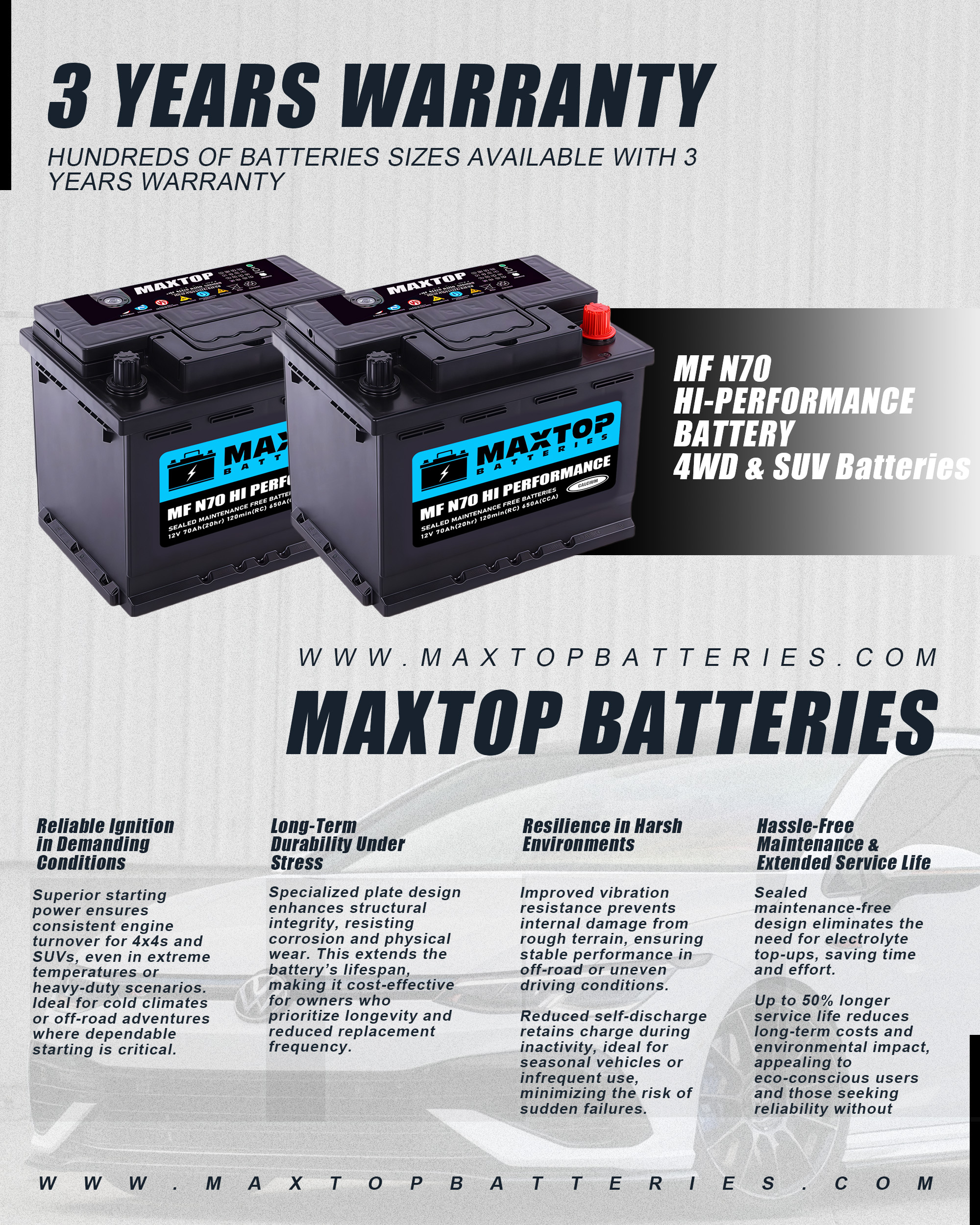
· High Cold Cranking Amps (CCA) (e.g., MF N70 batteries typically have CCA values above 660A)
· Vibration resistance, preventing active material shedding
· Low self-discharge rate, extending starting reliability after prolonged parking
· SUV Batteries & Truck Batteries
These larger vehicles have higher requirements for their batteries:
· Enhanced cycle life to cope with frequent charging and discharging
· Higher capacity retention rate to provide stable power for additional electronic devices
· Extreme vibration resistance to adapt to complex road conditions (DIN66 batteries place special emphasis on anti-vibration design)
· Material Characteristics of Batteries under Different Standards
· JIS batteries (Japanese Standard): Focus on compact structure and high energy density
· DIN batteries (German Standard): Emphasize precision manufacturing and vibration resistance
· MFN100L/MFN125/MFN180 Series: Use special alloys and carbon additives to provide excellent deep cycle performance
Answers to User Concerns
1. Why do some batteries fail early?
Early failure is often related to inferior raw materials: Impure grids cause accelerated corrosion, poor-quality separators lead to internal short circuits, and impure electrolyte accelerates sulfation. The use of recycled lead and non-compliant alloys are the main reasons.
2. How to judge the quality of battery raw materials from appearance and parameters?
· Weight: High-quality batteries contain sufficient lead material and are relatively heavier.
· Terminals: Sturdy, corrosion-resistant, with tight connections.
· Case: Uniform material, strong shock resistance.
· Technical Parameters: Stable capacity and voltage output, low self-discharge rate.
3. Why is there a big price difference for batteries of the same specification?
Price differences mainly come from:
· Raw Material Purity (High-purity lead vs. Recycled lead)
· Alloy Composition (Premium alloy vs. Standard alloy)
· Separator Technology (AGM vs. Ordinary separator)
· Production Process (Fully automated vs. Semi-automated)
4. How to maximize battery life?
· Avoid Deep Discharge: Try to keep the state of charge above 50%.
· Proper Charging: Avoid charging voltages exceeding 14.6V.
· Regular Inspection: Keep terminals clean and connections secure.
· Temperature Management: Avoid use in extreme high-temperature environments.
MAXTOP Battery's Raw Material Quality Commitment
MAXTOP batteries carefully select high-quality raw materials for different application scenarios and standards, ensuring each model achieves optimal performance:
· Strict Supplier Screening: Only cooperate with high-purity lead suppliers meeting international standards.
· Advanced Alloy Formulations: Use low-antimony lead alloys and lead-calcium-tin-aluminum alloys to optimize crystal structure.
· Active Material Improvement: Add special carbon materials to improve charge acceptance and deep cycle performance.
· Intelligent Manufacturing Process: Fully automated production lines reduce human-induced quality fluctuations.
Our MF N70 batteries use lead-calcium-tin-aluminum grid alloys and high-purity active materials to balance starting performance and cycle life; DIN66 batteries use enhanced grid design and special AGM separators to meet the high electrical demands of European vehicles; the MFN100L/MFN125/MFN180 series apply carbon additive technology and corrosion-resistant alloys to provide excellent deep cycle performance and high capacity retention.
Conclusion
The performance and lifespan of lead-acid batteries depend heavily on the quality of their raw materials. From the grid alloy to the active material, from the separator to the electrolyte, the quality of each component directly affects the battery’s reliability, efficiency, and service life. Choosing a battery brand like MAXTOP that focuses on raw material quality not only ensures the stable operation of your vehicle’s electrical system but also reduces the total cost of ownership in the long run.
When selecting a battery for your car, SUV, or truck, remember: batteries built with high-quality raw materials, with their longer service life, more stable performance, and higher safety standards, will provide continuous and reliable power support for your vehicle.
#LeadAcidBattery #CarBattery #TruckBattery #BatteryRawMaterials #BatteryLife #MAXTOP Battery #JISbatteries #DINbatteries